Tag Archives: Hiking

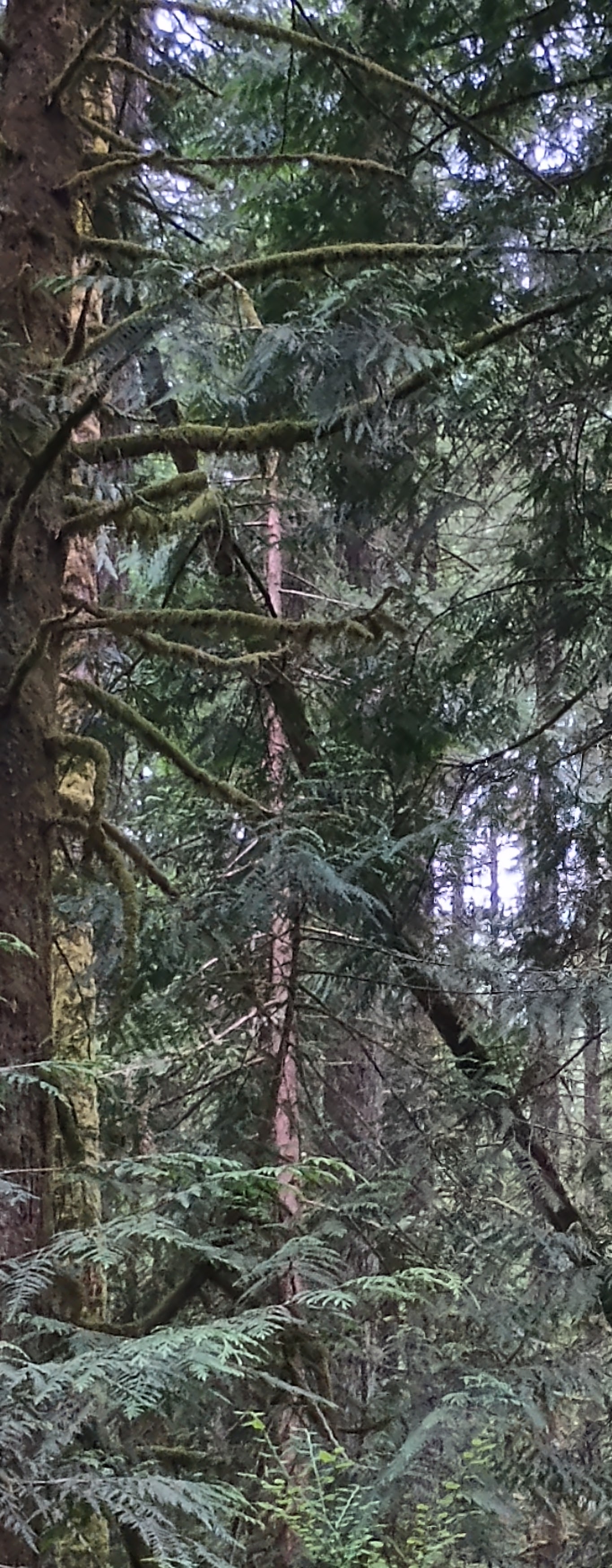
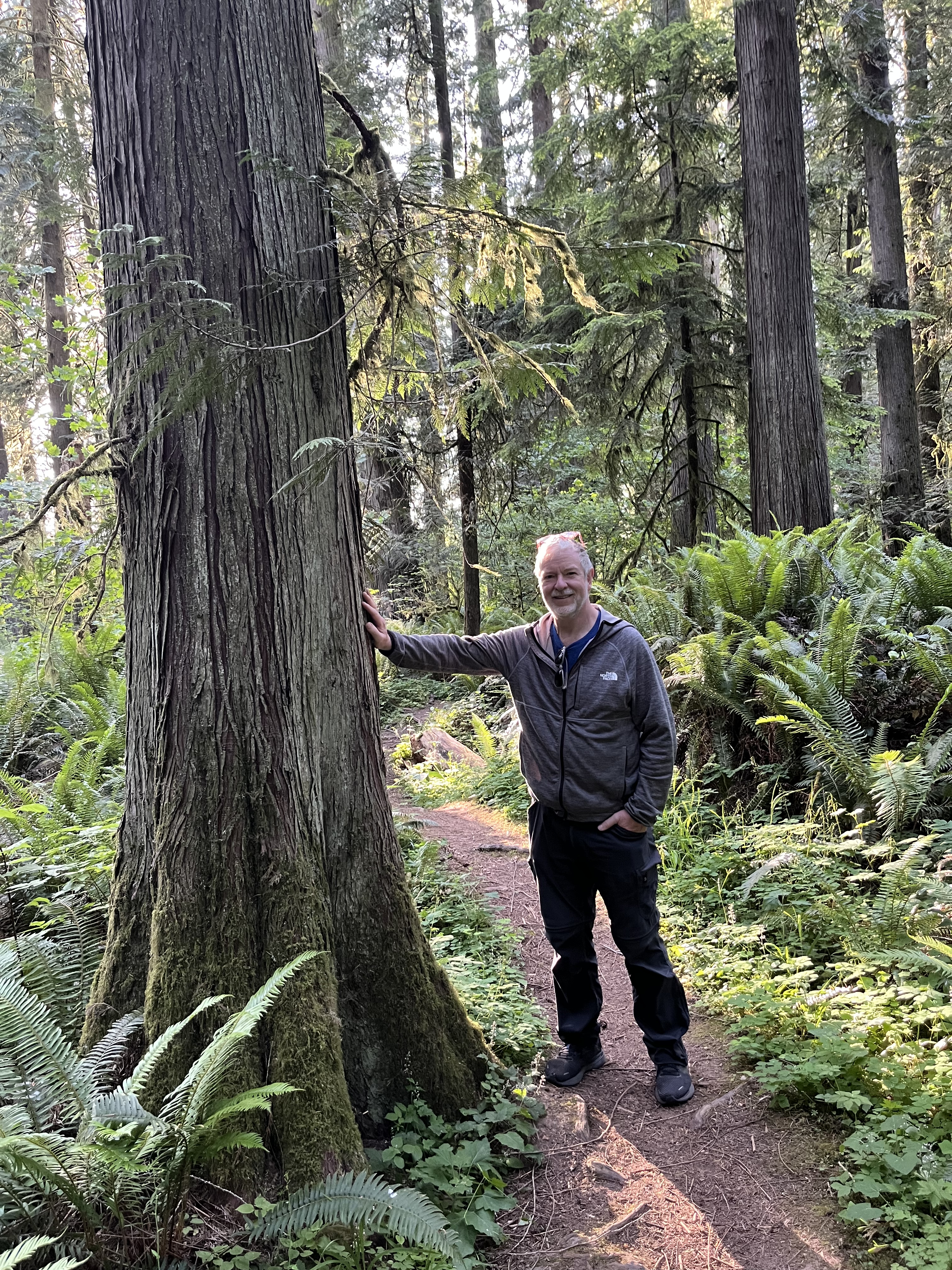
TREES, wow just wow!

This post was going to be pictures only, no words. Then I realized I am actually going through some complex processes and thoughts I’d like to share. Don’t worry, they’ll still be pictures. The challenge lies in all my prior knowledge, learning and innate beliefs being cast upon the reality of the woods around me.

I’ve always loved the woods; peace was found, trouble was hidden. Walking, riding, just standing and looking/listening/smelling. This trip sent us places we’ve never been and added not only to my joy, but to my understanding. The woods in Davis, WV were decimated by man for coal, timber and even bombing runs. The regrowth there is hard to fathom and so I mostly just ride there and enjoy the shade. Taking it in, but for granted.

Truly no expert on any of this, I’m sharing my own overwhelming introduction as it rolls from state to state. This road is changing and adding to my viewpoint. I knew from movies and pictures that the West and Pacific Northwest would be a spectacle and an experience. We’ve been in Alpine and Sub-alpine forests. I’d heard a tiny bit about Coastal Rain Forests but the name Pacific Temperate rainforest is the more correct term. These areas get almost 10 feet of rain annually and have mostly moderate temps from 50-75 degrees F year round. Lots of growing time and lots of competition for sunlight. The Alpine areas I love to ski in get snow and somehow survive the wild swings of harsh Winters.

We have truly embraced them all throughout, but the PNW trees have shaken me to more attention.  They have rescued us from the heat and unrelenting sun of the plains. We were surprised to be seeing a 101 degrees reading on the dash after leaving Three Rivers, Idaho.  We had been in a forest that was cool and crisp, loved adding a jacket and hat to cook breakfast. Suddenly, a few miles later we were shocked driving up the highway and hiding in the shade just pumping gas, placing foil in every window for only a few minutes shopping in a market.

Perhaps the first reprieve was on Moscow Mountain, Idaho with Lodgepole Pines, Douglas Fir and Western Red Cedar. The woods there welcomed us in and delighted with the green smells and breezes. Though we saw the beautiful areas, lush hollows and tight shady places in the rides, there were timbered places and widened dirt roads (like where we saw the moose and calf). Other than those roads, the timbered areas were not so obvious. But as we drove through the town of Troy, Idaho we were overwhelmed by the unmistakable smell of cedar and witnessed a sawmill working through the night. Quite a busy sawmill with acres and acres of cut timber lined up and readied for processing.

I reminisced about the nice forests in Montana near Red Lodge. There we also witnessed thousands of acres that had burned. We heard of fires in 2020 and other years, noting bare places of carnage and seeing new growth beginning to recover. We found burnt pinecones in places spurred by the fires to send out life. We saw so many bare acres we seethed when we saw kids at the next campsite playing with a fire in their dad’s brief absence. We nearly grabbed the host when luckily the dad came back and tempered the kids by stopping their games with leaves and pine needles.

Then driving further West into Washington, we were again assaulted by the hot sun on the plains. So much so that we took refuge in a Quality Inn. Air conditioning, water refill, a shower and charge-ups of all electronics were needed along with the almost 9 straight hours of sleep.

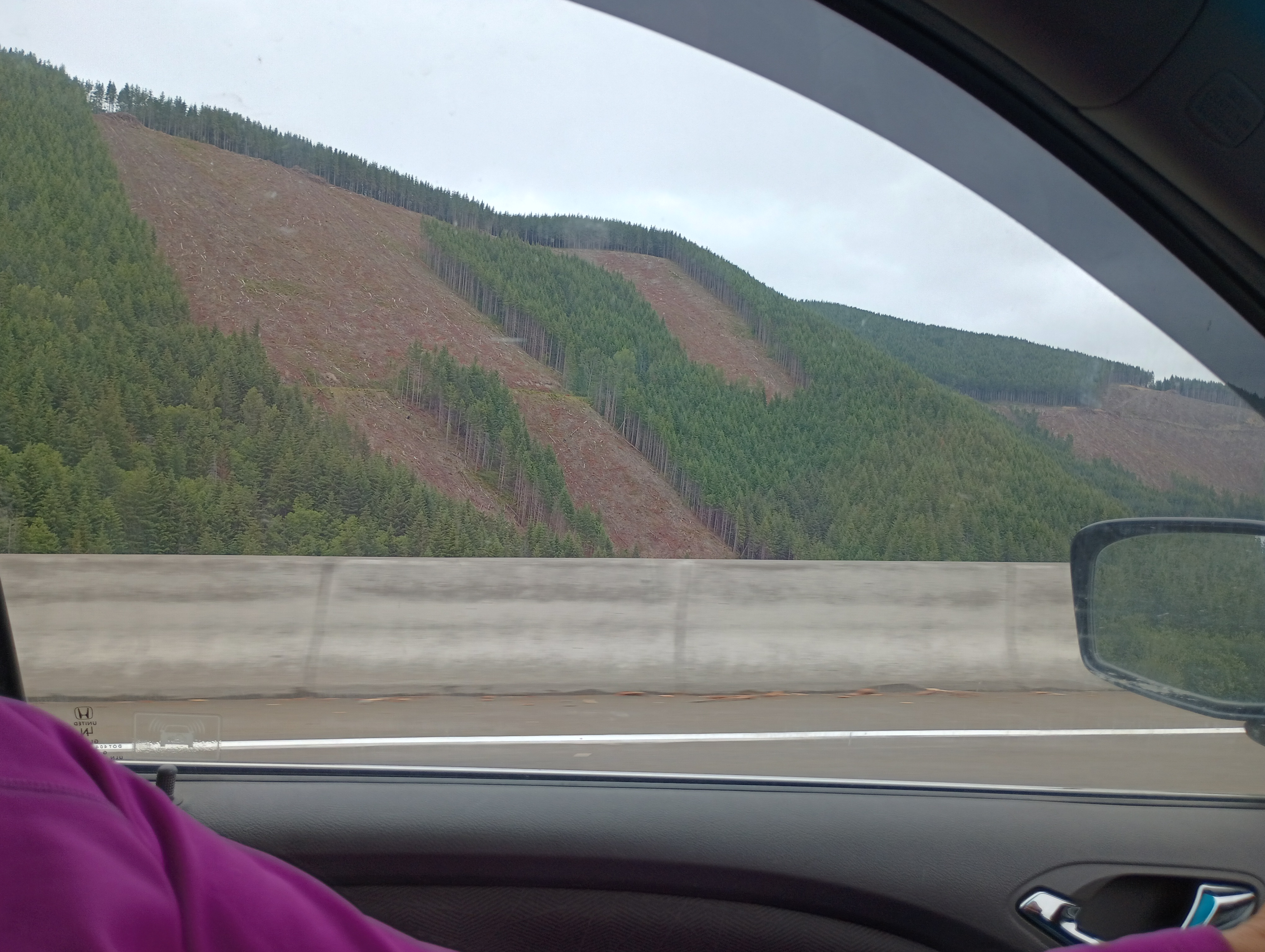
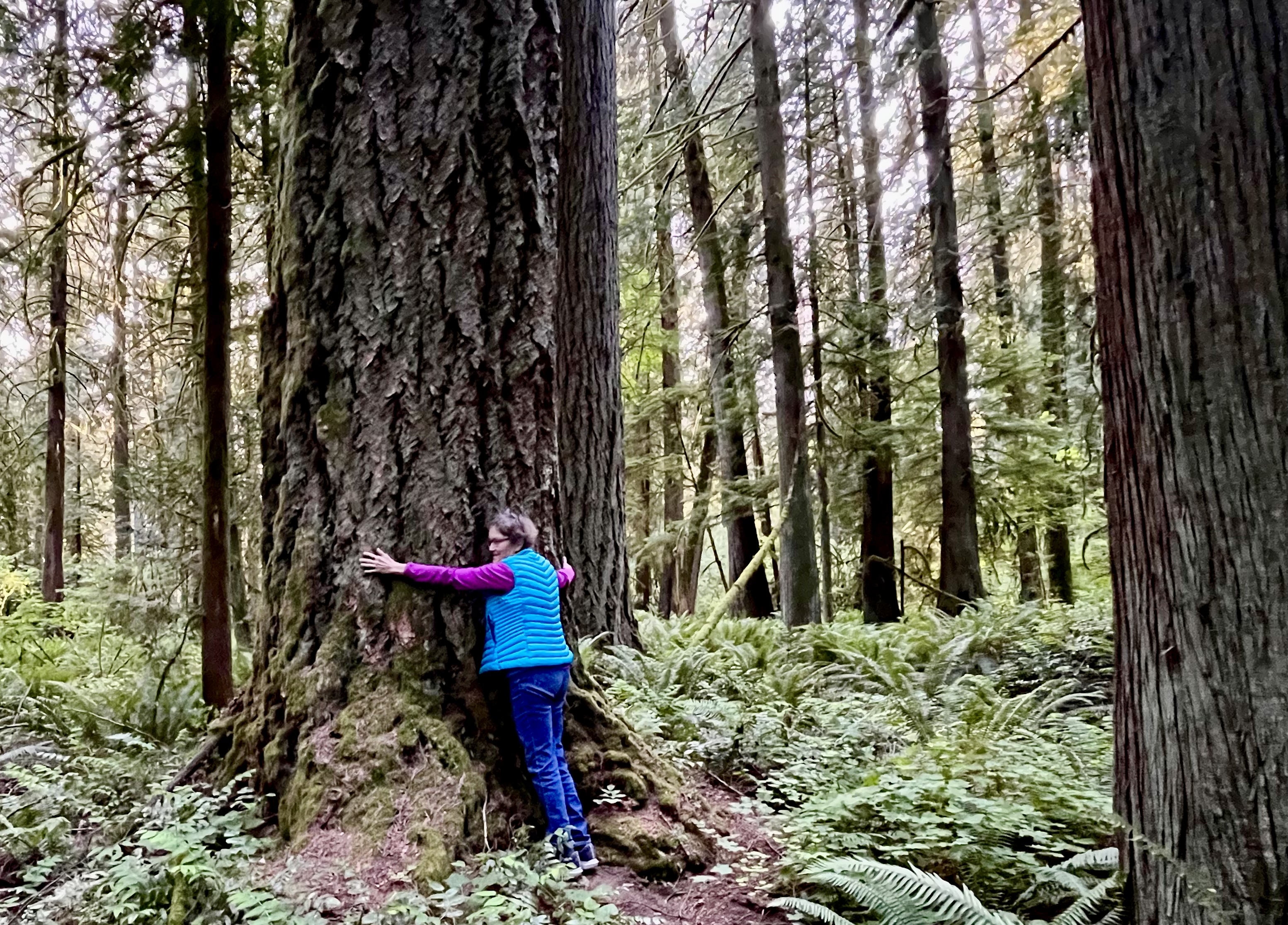
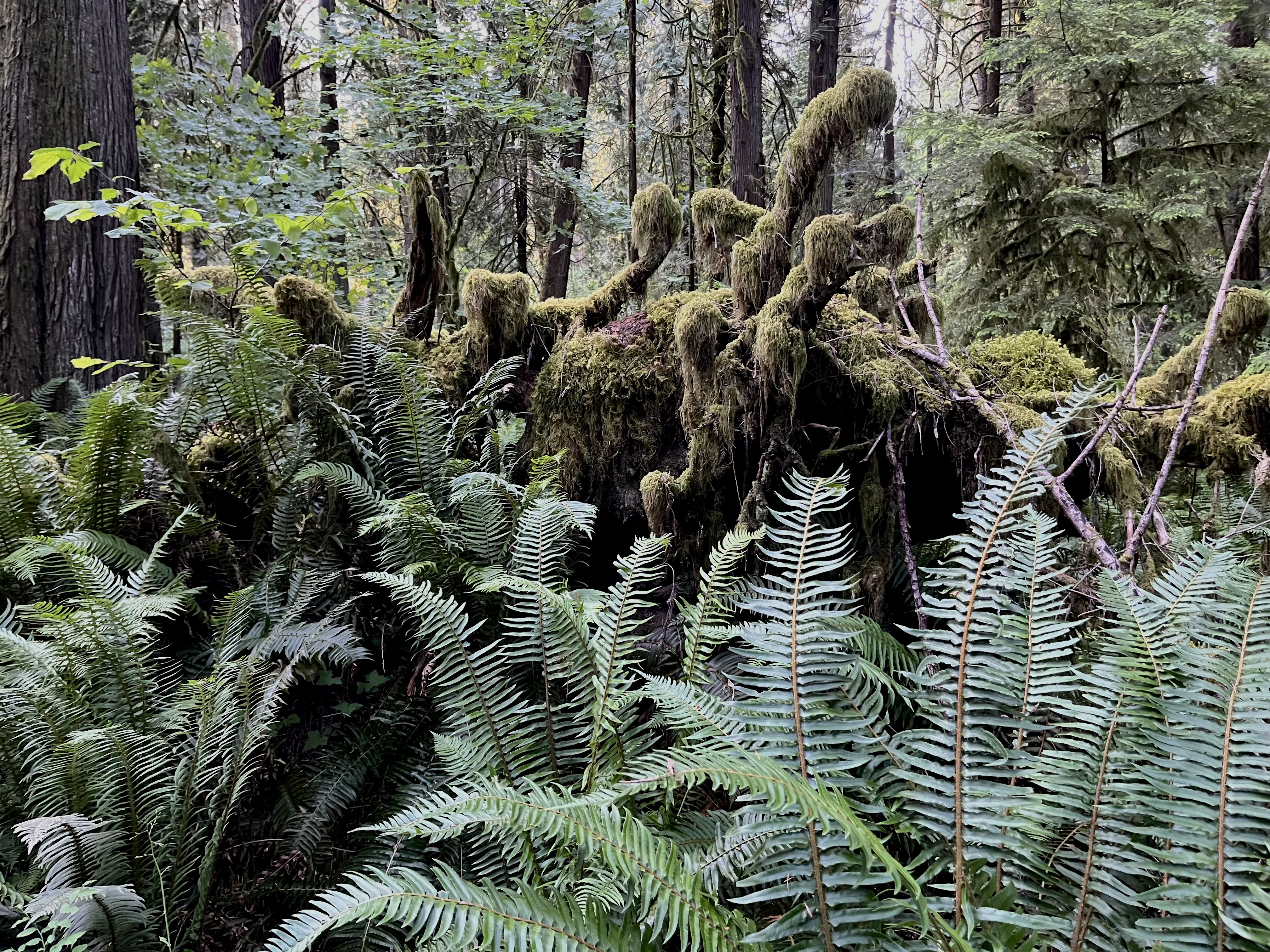
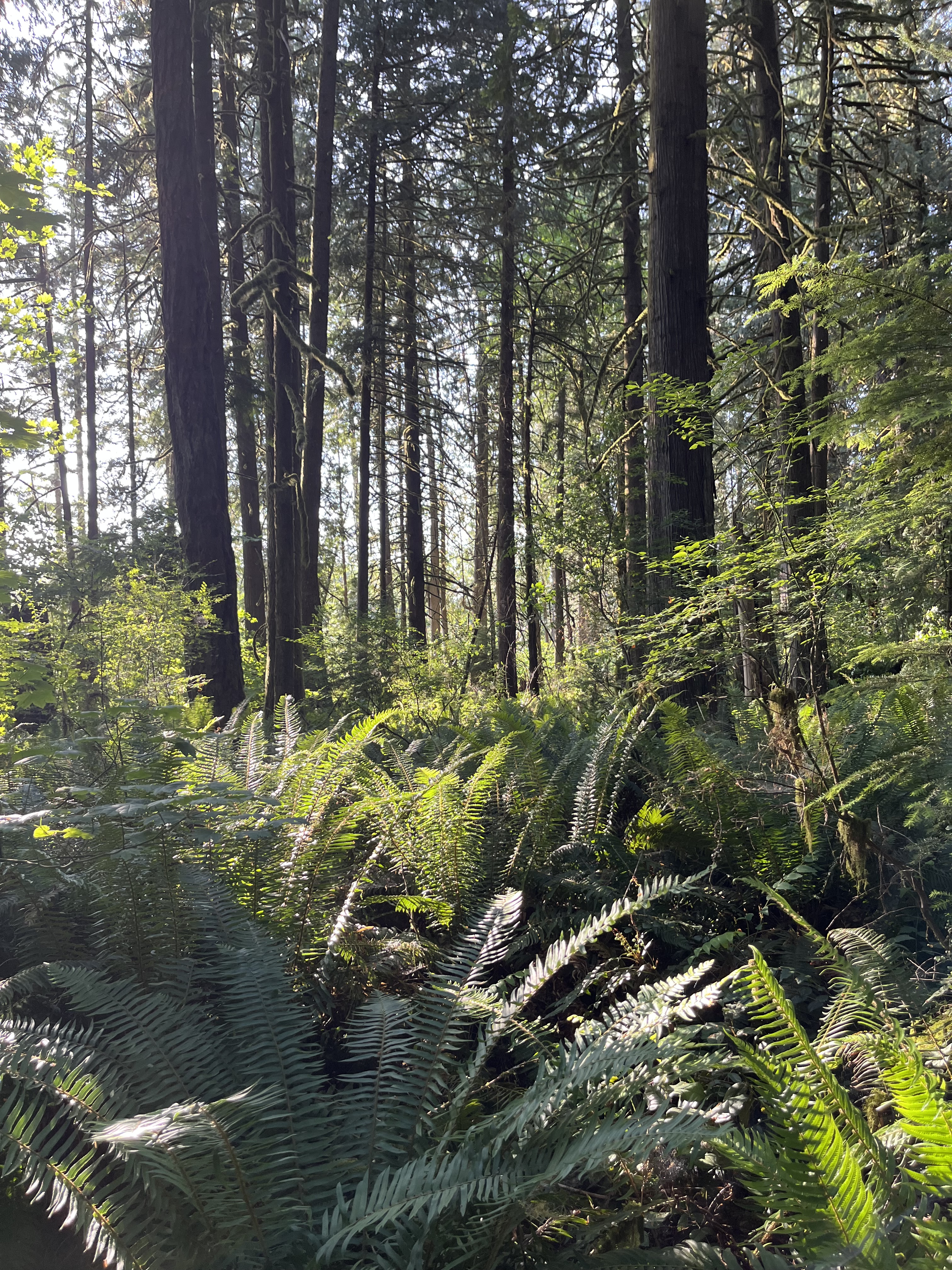
The next turns included traffic jams in Seattle, then to Dash State Park South of Tacoma. Another great forest! Still brewing my reactions we went to perhaps the “oldest growth” yet in Lewis and Clark State Park. The first day trip from there took us to Mt St Helens. During the drive we saw bare hills, roughly stripped of every tree, other mountains stripes of tall trees between bare patches. Whole mountainsides denuded of all trees as well as varied areas replanted and labeled with the year planted. But the 616 acres were an amazing refuge in Lewis and Clark State Park, so much we stayed two days. The green, ghostly snags and even living trees were massive co-working organisms to gawk at. They got me looking, thinking and writing all this stuff.

Suffice to say, between natural fires, large and small, Cataclysmic volcanic events and logging we’ve seen trees challenged, blasted, scorched and removed. Filling our knowledge gap came from an unexpected source. We went the road less-travelled and entered Mt St Helens National Volcanic Monument bypassing the National Park Entrance and visitor center.

This led us into a Weyerhaeuser “Forest Visitor Center”. We braced ourselves for logging propaganda but got much more. The cataclysmic events of the eruption took out 1500′ of mountain May 18, 1980 was a natural event that decimated 130,000 of acres of trees. The river was completely changed and raised ~180′ by a 5.1 earthquake and the largest recorded landslide ever with boulders, piles, silt and massive glacier melt flooding. The mountains all around had trees leveled like toothpicks. Nearly 68,000 acres was being managed by Weyerhaeuser before the blast, so they were integral to the plans for recovery and replanting. (Of course they harvested every bit of lumber they could over the two year period)

Inside the blast zone nature was allowed to take its course. Jane and I hiked the “Hummocks” area in which nature alone was allowed to shape the recovery. The Hummocks are hills formed by debris, with pots of sinkholes from melting glaciers as well. The trail wound its way upward and around some areas where old growth trunks were still visible, protected from the blast but dead all the same and clinging to where they had stood.

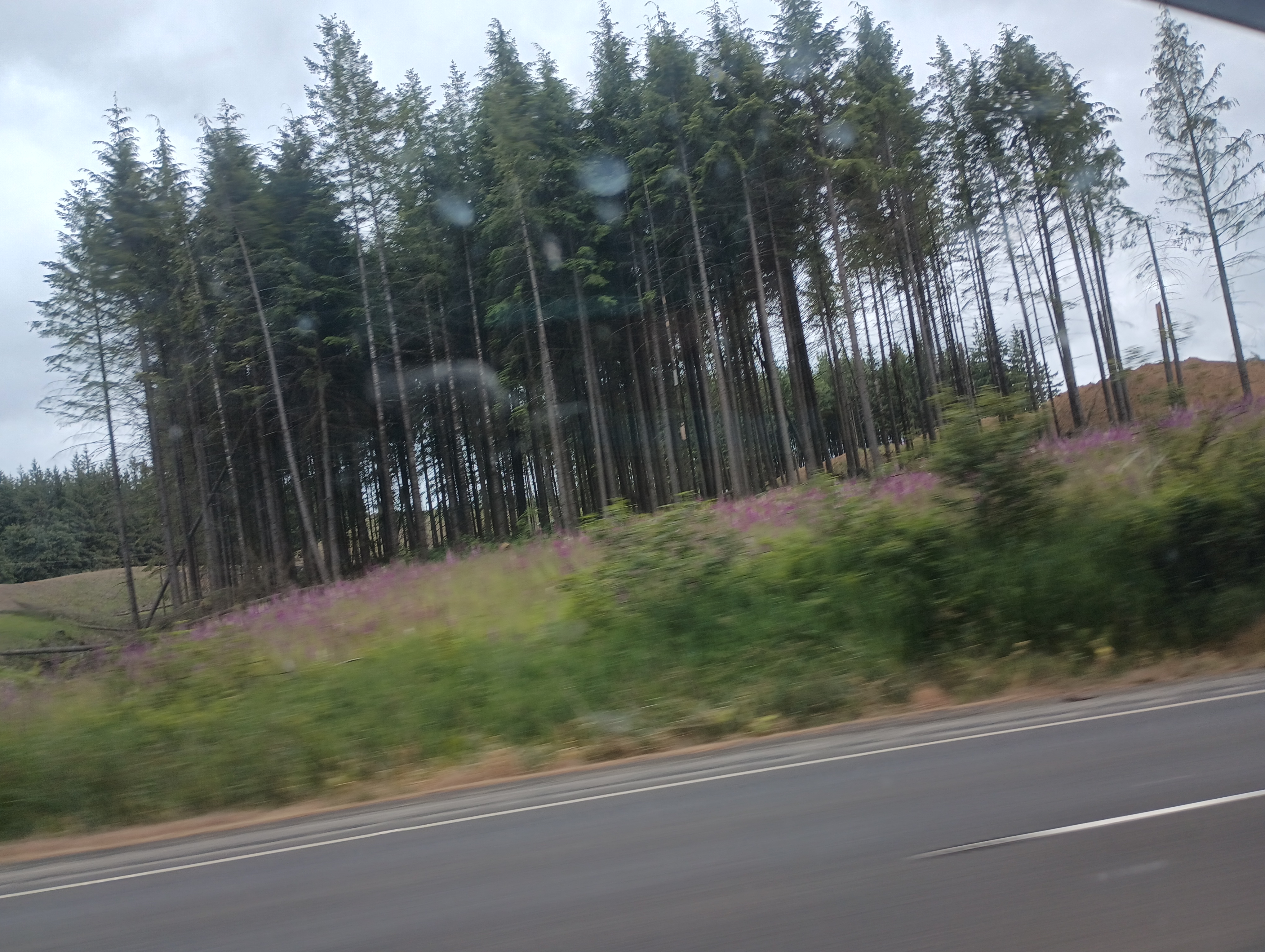
Outside the blast area and on their own properties, the timber companies prepped and planted on a massive scale. The natural areas have deciduous bushes, trees and early conifers but are far far behind the planted regrowth in the timbered areas. These had multiple layers and plots of trees of varied heights depending on when they were planted. The mature ones started in 1982 look “almost” like a natural forest. But, they had a sameness, a lack of variability that betrayed their nature. They were a near mono-culture. They looked “too perfect”. So now I’ve seen layers and layers of nurtured forests. Often they lay 50′ from the road, hidden by a thin veil of uncut trees or bushes only seen over big hills or turns. The secret bare places or trees planted 4, 5, 10 or 15 years ago hiding in plain sight. Enjoy the pics, sorry it took so long to share.

The trees individually and as forests thrive, grow, change and return any way they can. Of course we’ve all seen the sidewalks cracking from incessant return of roots and time. I don’t have much of a conclusion or summary, but I see the expedient return by the logging companies for profit. I see the slower more random way nature takes over, but most of all, “I see the trees in the forest”.

13 miles away in 1980! (Blasted by The eruption)
Stumps left from the blast
planted 2021 (sorry for terrible pic, these signs are rare and pop up quickly)
The ones to Left of car are about 5 years old, toddlers
This was pretty much someone’s small farm of trees
Some examples of stripes of different ages
Burn from 2017 above Oneonta Gorge
Burn from 2020 deep into canyon near Red Lodge
More near Red Lodge (at first we didn’t know it was all from fire, we just saw dead trees and blight)
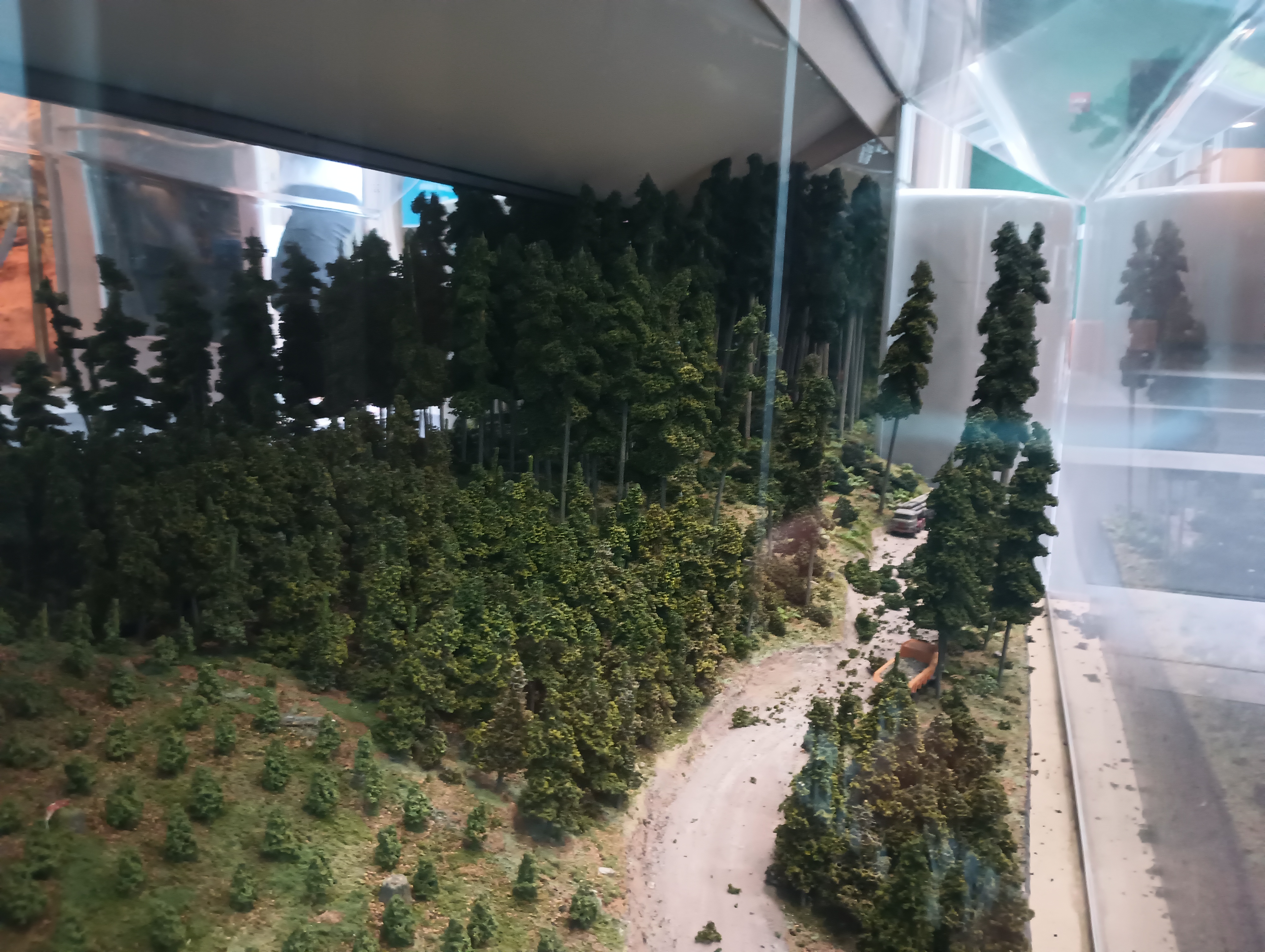
Diarama at Weyerhaeuser visitor center (Forest Education center)
Some goods we saw down the road, sheet goods. But they sell lots of boards, we saw literal mountains of sawdust near Portland
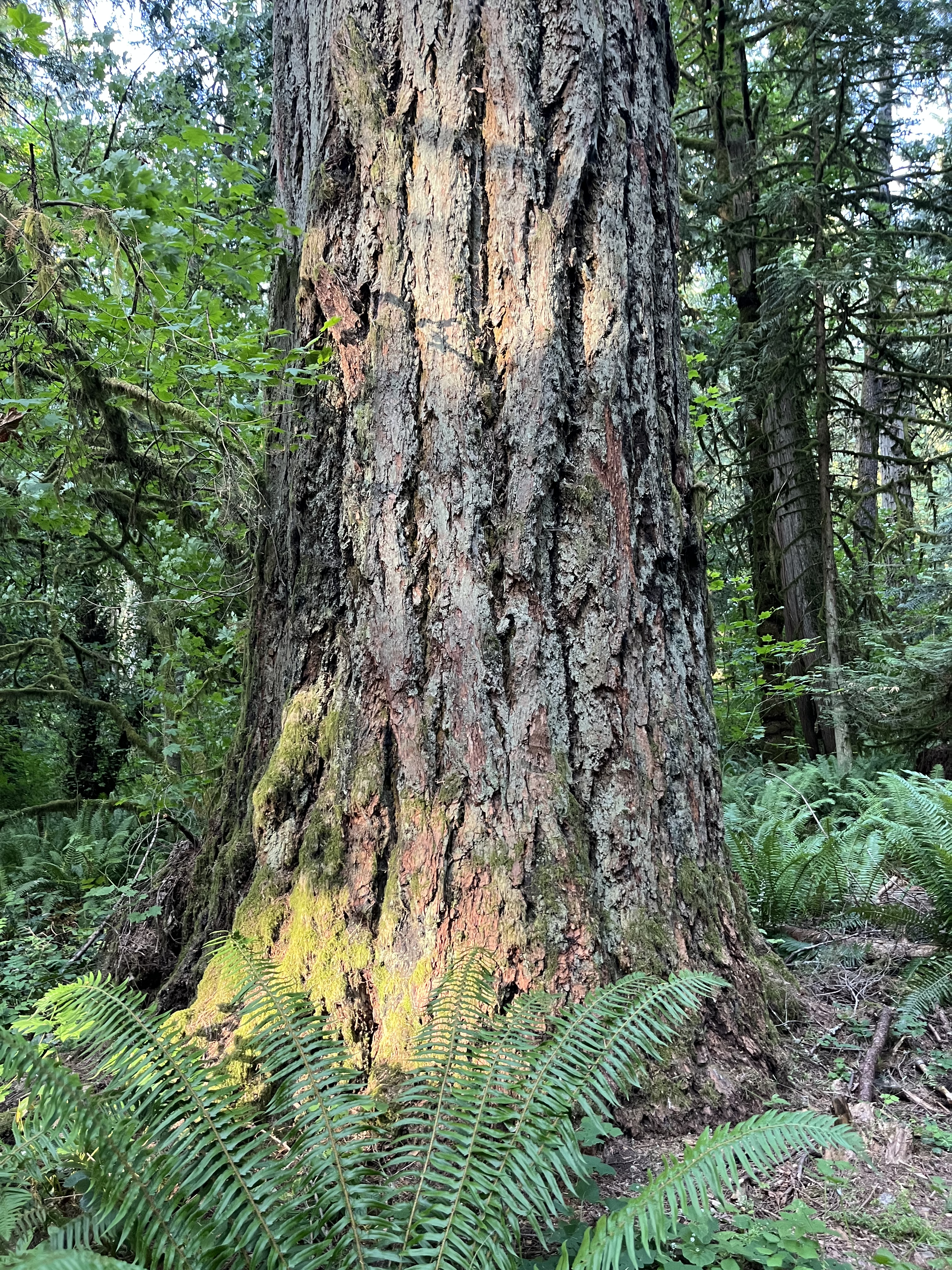
A tall snag, supporting insects and birds for 100 years before falling and enriching the soil for the next 50.

David

(Written in Ainsworth State Park, Oregon, Columbia River Gorge)
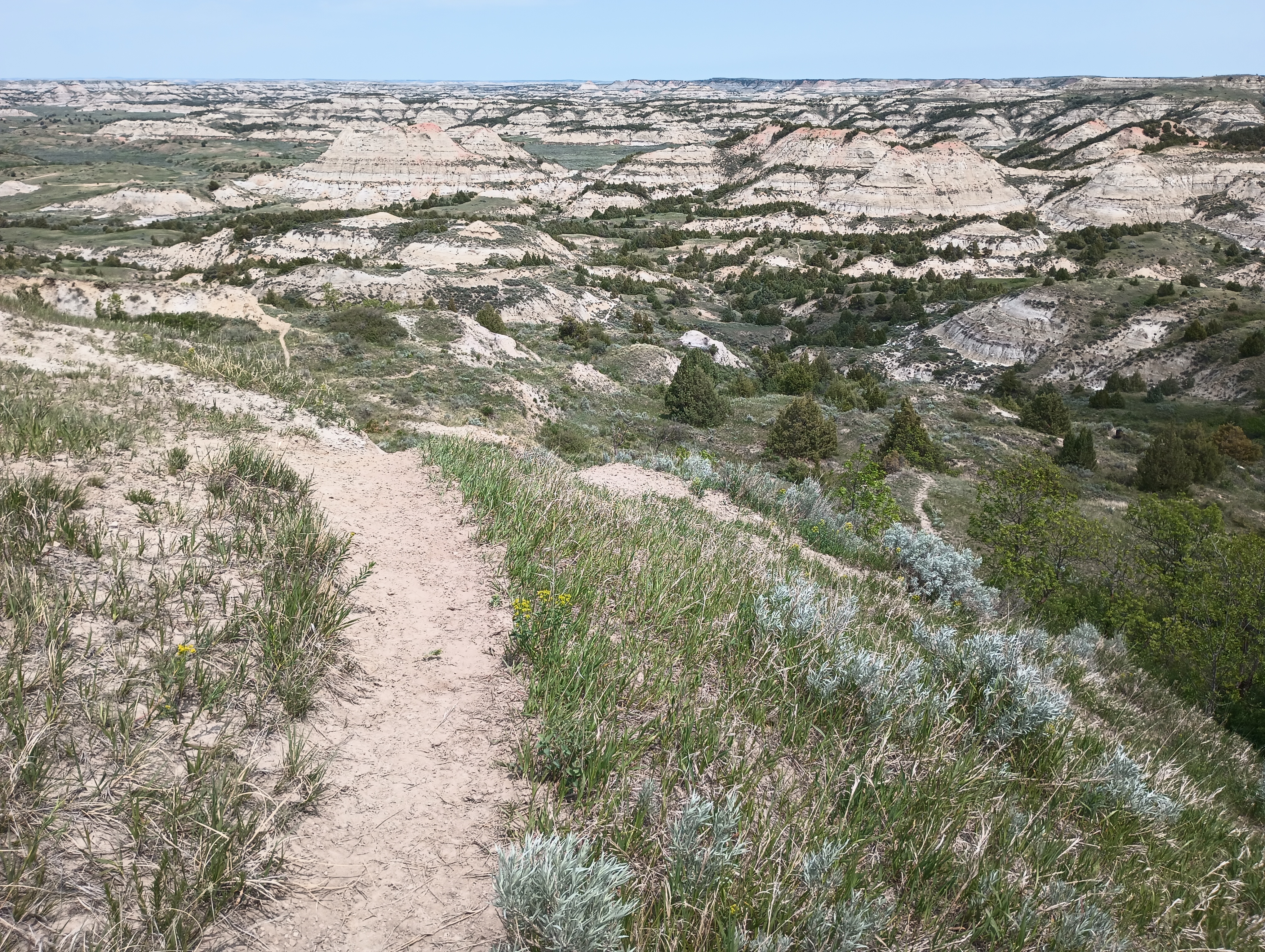
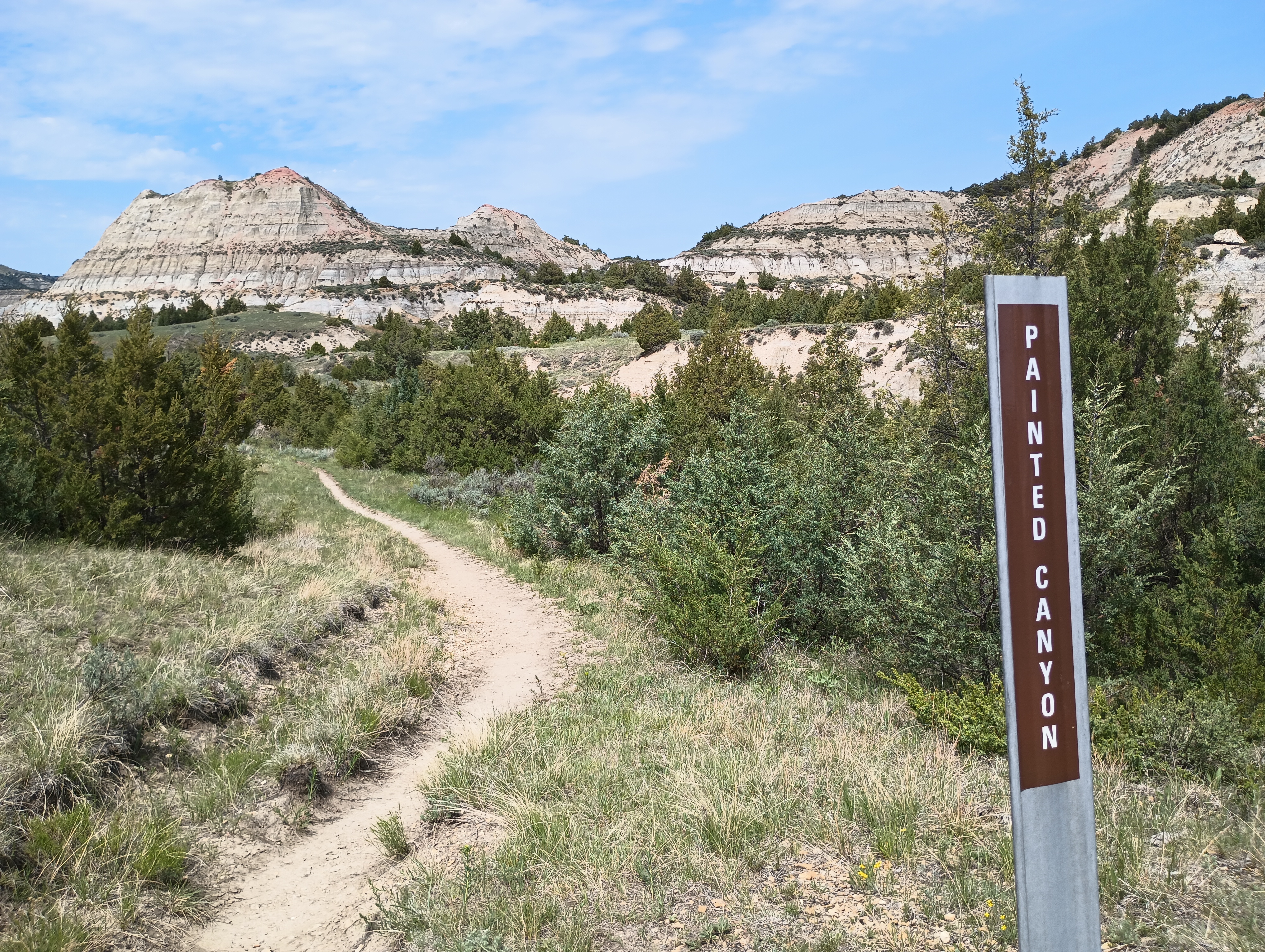
Just another day in Theodore Roosevelt NP, Day 13 Hiking the Painted Canyon Trail (after a horseback trail ride/horsie-day)

As usual, one activity wasn’t enough so we went off to the visitor centers to talk to rangers about a good hike to complete the day. We listened intently to the basic bison instructions, “there may be a herd at the visitor center fields, but they are pretty docile right now, not calving and just move slow, keeping your distance of 2 school buses or more”. “They may be grazing near the trail, but you can go by, just be predictable, talk low tones and don’t go closer to them”. We picked a trail with plenty of elevation change, it drops down into the canyon with switchbacks immediately after a half mile on the flat.

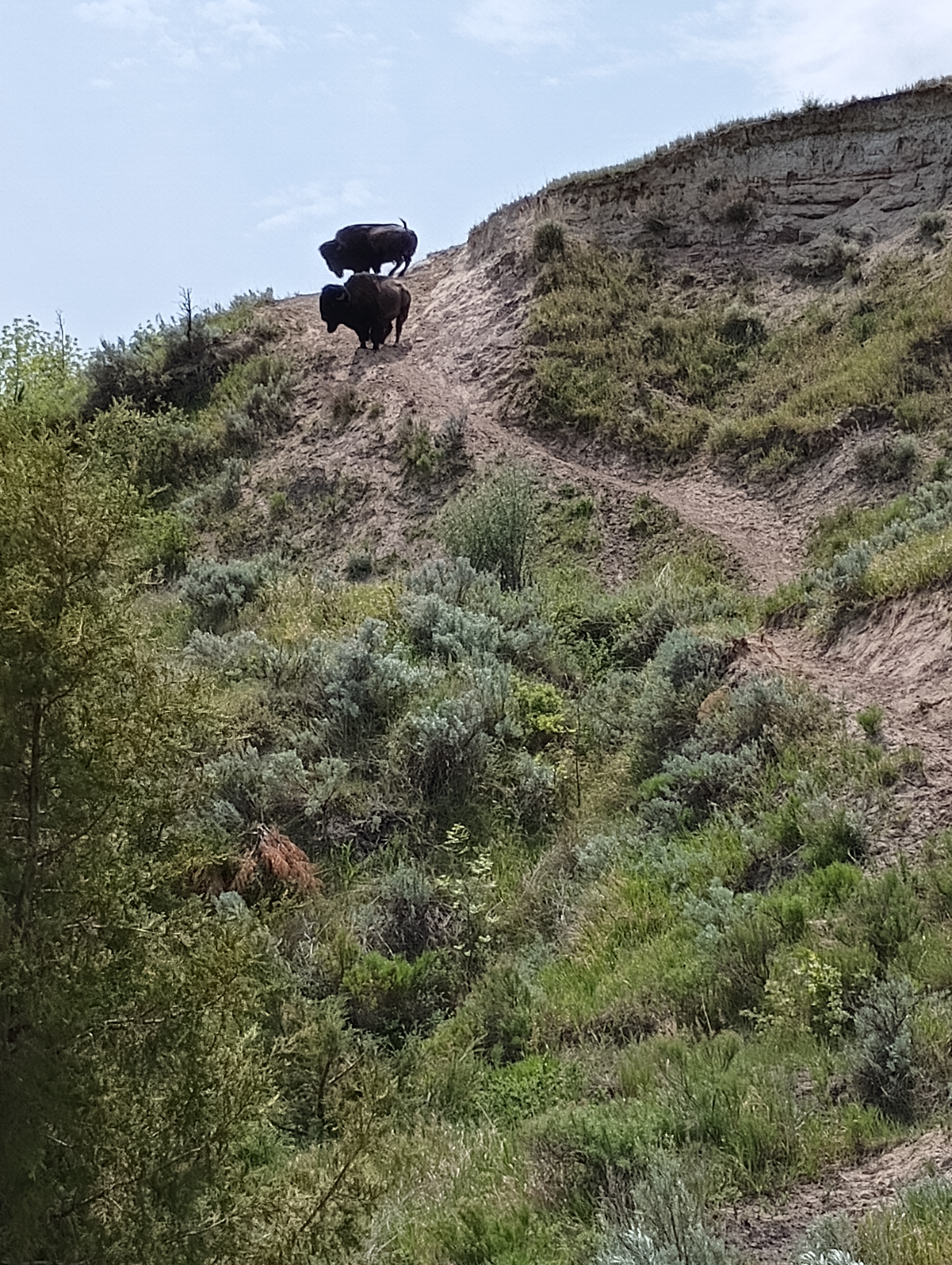
The trail was dusty-dry and dropped steeply, enough so that I was sitting my butt down a bit to dig in the heels of my boots. Yes, both of us prefer heavy boots above the ankles. We know that real hikers, even AT hikers wear trail running shoes, but the tread and weight of boots is protective and predictable. yep, immediately near blinding down a narrow single track we weren’t more than 1-2 hundred yards in than I looked back and there were bison following us! I told Jane, sending her ahead of me and said I’d figure out if they were faster or slower than we. It seems our natural pace was just a bit faster, so I pressed to keep going as we surely weren’t going to go straight up that pitch to head on with a bison.

After later telling a friend, he mentioned he knew a guy who butchered a large male and its head weighed 600 lbs. The bison knew their trail and my luck such that it is, led me to keep us going down further and take a right turn on a small game-trail looking spot. As we leveled out on a plateau, we looked back again and the crew of four took a left and went to the watering hole. Boy were we glad!

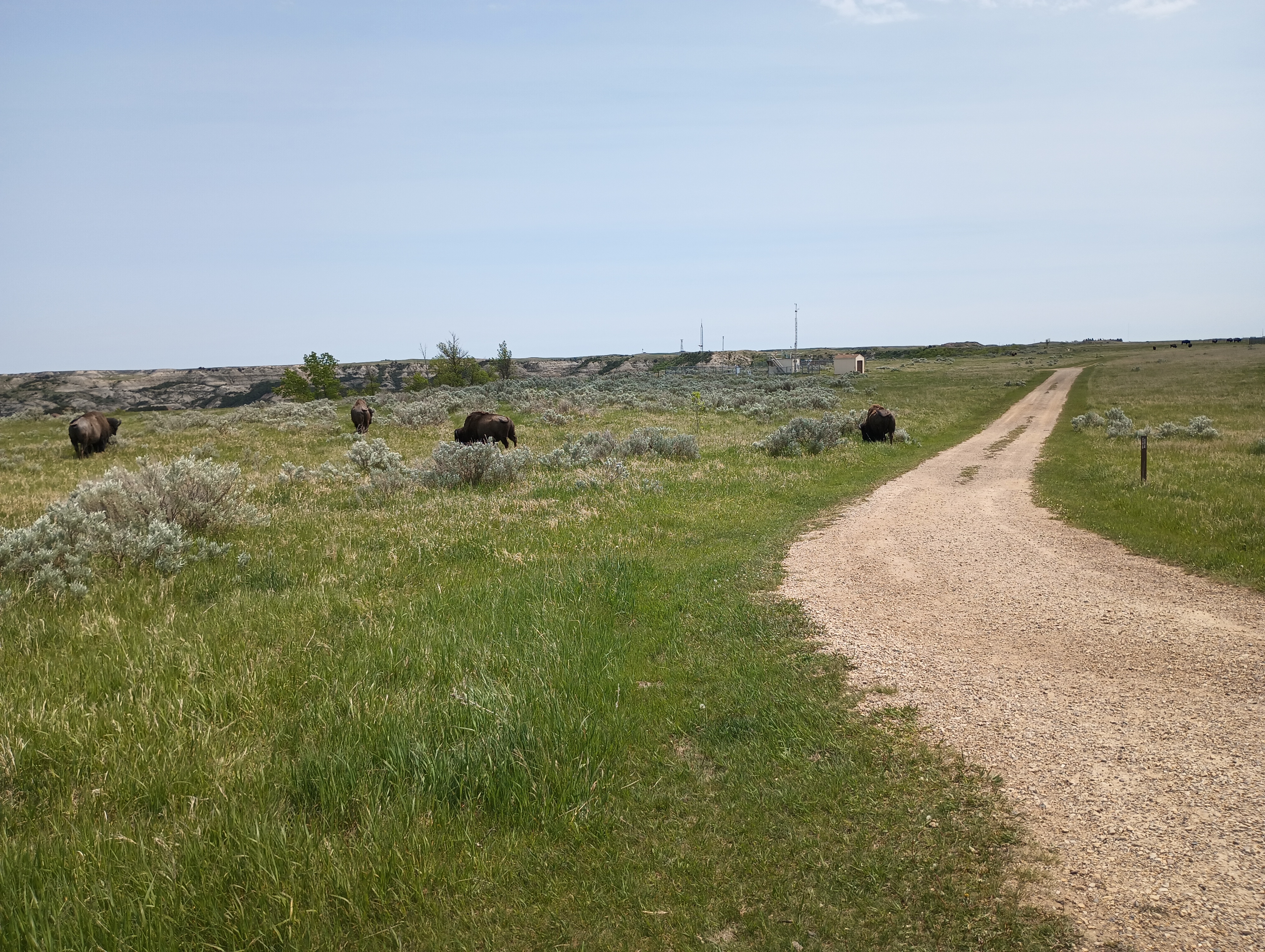
It was a very nice, strenuous hike with 1000′ of descent to be climbed on our way back out if we did the whole trip as an out-and-back. We did do that, going through about 3 Liters of water, wearing dorkie hats, sunscreen and carrying a day pack with emergency supplies worthy of any overnighter. The hike went fine, we only saw people when we were about 3/4 done. On the climb we didn’t kid ourselves as we knew the herd would be grazing somewhere or another. Yep, right on our exit trail up on top. The ranger had told me that bison were the only reason to leave the trail and if they were blocking, it was okay to walk across the meadow and skirt around. And skirt around we did. Jane and I stopped for several long minutes to try to study the herd and decide if we’d be sleeping somewhere on the far side of them?

It was a long wait, but my call was to walk out into the middle of the field, outside of the first two. Then we kept going at that distance until we saw the clear chance to walk back across the field to get back onto the trail. By this time, all of this was in sight of the Painted Canyon visitor center and a huge parking lot.

David

Logistics: How’s that working out for you?

We decided to be stealthy, use a minivan and avoid towing and all that goes with it. Ideas on paper don’t always go the way you hope. Our first foray into minivan-stealth was during an October trip to Stowe for second-cousin Caroline’s wonderful wedding. Without any real prep other than a camping box and air mats we slept in the Adirondacks. Little things like cup holders and handles at the ceiling were noted to be needed and kept for sure. Later I added a thin wooden riser to level the whole back to be above the heavy metal clamps that usually hold the seats in place. We bought 3″ upholstery foam, deciding that two 24″ wide pieces would be easier to manage than a single 48″ mattress. Jane sewed some delightful covers with inexpensive “Nearly-New” fabric.

Cooking:

While I still have and use an ancient Coleman white gas stove for camping, it stinks when you turn it off and I didn’t feel like carrying a can of white gas all across the country in a minivan. (Though in a pinch that could’ve been a spare gallon to burn in the car). Many of the propane stoves are pretty big but we found this wonderful one at “Nearly New” it’s a Zebco, so full of adolescent appeal, think fishing supplies.

Then back to fuel. I didn’t want to leave a trail of green propane cans which are usually not recycled. Solution, IGNIK is a company who makes small propane tanks to be refilled. Holding approximately 5 of the green cans, it cost only $4.00 to fill. Update coming on how long it lasts 

Coffee:

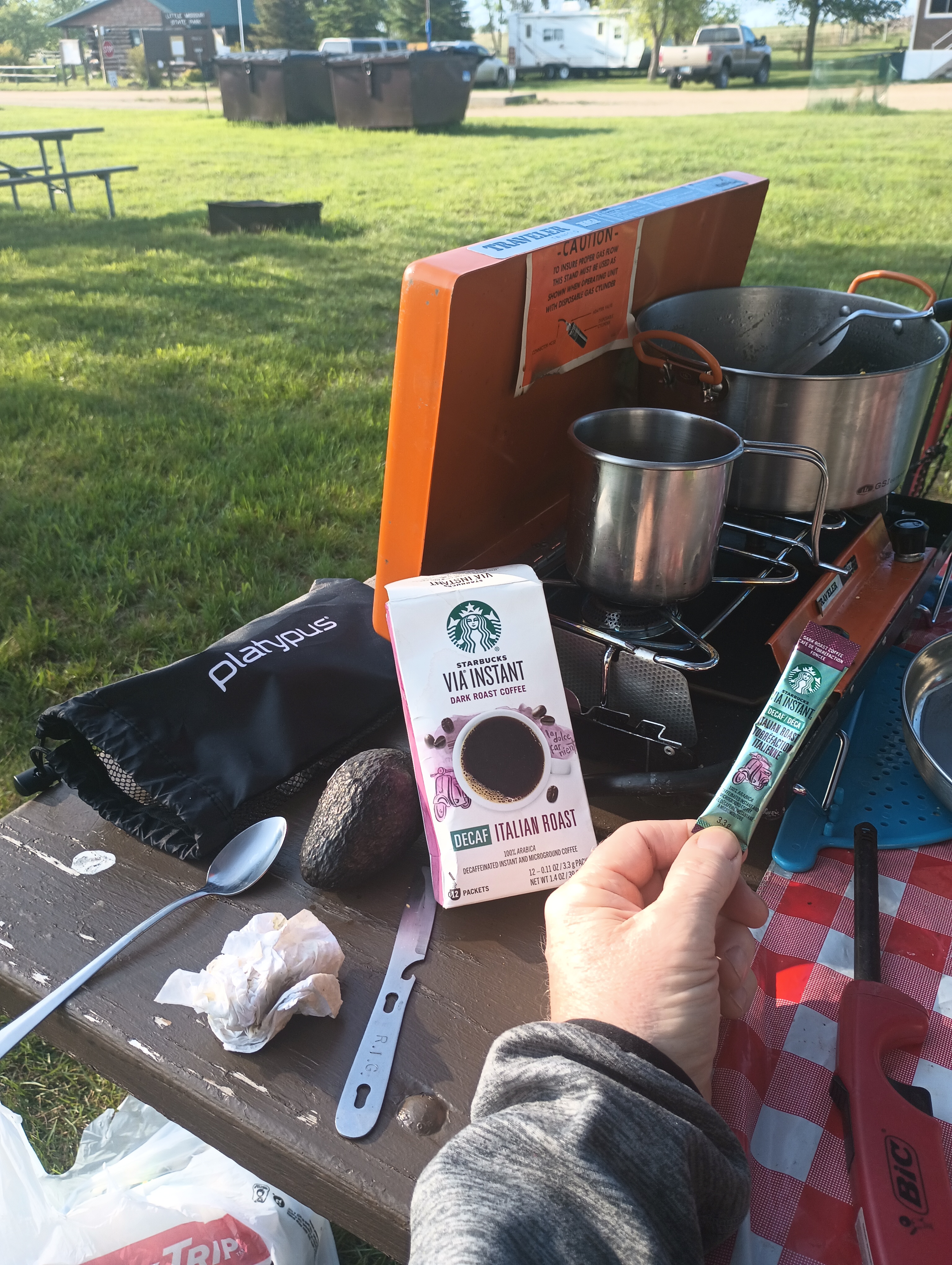
Jane’s not drinking coffee so I didn’t want to brew for one. Solution, Starbucks Via. The only instant I’ve ever had that tasted strong and consistent.

Power:

Charging Jane’s ebike was my first consideration and I went through numerous ideas and iterations including wrongly buying two inverters while searching for pure sine wave. Then after suggestions from Phil, a technical friend, I looked into it and realized it was going to burn up the minivan alternator trying to pull 150 amps from 130 amp system. (This highlights the joy of friends and people who add to your life, their knowledge comes in handy)

Again, thanks to Phil I researched Bluetti and Jackery as camp power solutions. As whole systems they would include solar but I saved some money by just getting the 1000 Watt model and charging it at electric sites as needed.  Looks like it will go at least 4 days worth of travel and Mt biking and refrigerating before needing a recharge. Maybe someday I’ll add a solar panel too, but not this trip. 

Cooler:

Everyone who has ever camped knows the pain of getting, keeping and sloshing through ice to have fresh food available and not soggy. With that in mind I started looking at electric coolers/tiny fridges. We are SO glad I did.  May not have selected the best cooler, but the Megiu 26L is doing the job perfectly well. It runs on the 12V “lighter” outlet while we drive, stays cold for hours if left off between drives and the Jackery too will run it (could probably go 4 days straight without a plug in)

And, in typical fashion, two days before launch I made a quick, simple cover for the cooler with an insulated liner to “keep it out of the sun” and give us a table between the seats in Helen, the faithful Honda minivan.

David

Here-we-go-again!

The current image has no alternative text. The file name is: bikeson-the-roof.jpg

For our last trip, I picked leaving in Fall, to arrive and ski as long as possible. That turned out to be 42 days in Colorado, mostly at Monarch on the Continental Divide. We savored a few other resorts, Loveland, Copper Mt., Cooper, Beaver Creek and Purgatory among others. We lived in our beloved Tramper in the coldest Winter in our “vortex” above Salida. Jane longed to hop out onto warm grass so much that upon leaving CO for home, we went West. The Grand Canyon afforded 15 degree f in February, but at least as we hiked to the bottom, it was 60. The foothills of the Sierras in Three Rivers were a delightful change, but once we headed East towards home on I-70, of course I got to ski again in Loveland, and our “Carney Nature” was key to being able to park on an upper lot during a storm, guided by a nice security guard who instructed us to move down by 5:00 AM when they would plow that lot.

That, of course brings us to this time. Jane picked Spring! She wants to see Teddy Roosevelt National Park. During our informal scouting moments, she also announced the idea to start at Cape Henlopen, DE and dip our toes into the Atlantic. I knew instantly where that led. Our trip will partially be guided by folks we can say “hi” to along the circuitous way. “Mapquest” says it 41 hours driving past Milwaukee to Kirkland, Washington. That’ll be an easy 10 day drive with stops added. Of course one of our guiding questions to locals met along the way, “what should we do tomorrow?” could easily add 10 more adventurous days to that path.

Last time was a 1957 Yellowstone camper I resurrected, towed by a ’95 Toyota Forerunner that was not really up to the task. Trailers teach you a lot about backing into places you think you can fit. They teach you that even a small engine working hard, gets <10 mpg. This time we move with more stealth and economy. We also don’t expect to do an undecided number of months on the road. (You can sigh with relief, there won’t be >180 posts/6 months to follow us this time.). We are expecting, not planning about 4-6 weeks.

I’ll detail just a bit about our selected vehicle. We had our usual adventures even finding this one. Budget of <10K, we saw lots. We “spoke” with quite a few Facebook Marketplace and Craigslist sellers who turned out to speak no English. Using “Translate” on a phone is a tough way to haggle. Some of languages we expected, African and Philippine dialects, but the old Italian speaking guy surprised us a little. (The texts with syntax errors did give us clues about ESOL). Finally, we found a Pakistani guy whose price on a high-mile 2010 Honda Odyssey was well beneath our budget. I will admit his fast toss of his phone to show me the one-owner Carfax led me to spend my own $40 to get a copy of my own. A few oil changes, brake inspections and the brief ownership of a 200,000 mile vehicle informed me it was a “keeper”. We paid to extra ~$1000 and had a timing belt, water pump and serpentine belt put on.

Driving the new friend and dreaming this Winter began to inform my plans. I never imagine being able to plan anything without free-thinking ideas for a few weeks at least. Ideas that seemed great are replaced by better at odd times, in the shower, or riding a bike. Brains are to be cherished, fed and allowed to work their own way sometimes. We camped (slept on the empty back floor) in the Adirondacks in October on the was to Cousin Caroline’s wedding in Stowe. I did the same solo for a bit Spring skiing at Mt Snow VT. Again, “where should I park?” asked at a local restaurant, led me to a plowed lot at Haystack MT, and abandoned ski area where a handful of other cold-weather vehicles moored for the night.

It was these one-two night forays that led me to sort the features of an empty minivan into an “action plan”.

David

Photo of the Week #11 – The Mysterious White Van

You remember the White Bronco, don’t you?  You know – O.J. Simpson’s getaway car? Nineteen years ago this week, the White Bronco entered into infamy as OJ tried to flee. He didn’t escape his fate. Not then, anyway. He actually did escape his fate later, though, during the ensuing trial. By being found not guilty of the murder of his wife and her boyfriend. Now, in 2013, OJ has a sad little life. In jail, awaiting a judgement on whether he can have a new trial for a mess he got into in 2008 when he was found guilty of breaking and entering.

Enough about OJ. He’s not really worth any more words. But, our Photo of the Week #11 is!

Day 176 of the Voyage of the Tramper 03/05/2013

Trailhead – Zion National Park, Utah

OLYMPUS DIGITAL CAMERA

Another notable white vehicle. Not a white Ford Bronco. A white Ford minivan. And, not infamous, just interesting.

A Google search of  “White Minivans Against Oppression” turns up nothing at all. So, we think it’s a just a bit of wordplay that doesn’t mean anything. A gently sardonic phrase meant only to adorn the side of said white minivan. Painted on there by an artist with absolutely no respect for the sanctity of the American minivan!

Here’s a couple of shots of more good art on the van:

OLYMPUS DIGITAL CAMERA OLYMPUS DIGITAL CAMERA

Thanks, minivan artist, for some interesting pics!

– Jane